If you're a developer looking for a Figma alternative, you're probably not looking for another design tool with layers and artboards and a properties panel. You're looking for something that fits how you actually work: in your IDE, in code, with AI doing the heavy lifting. The best Figma alternative for developers in 2026 isn't Sketch or Adobe XD or even Framer, it's an AI design agent that generates polished UI directly from your codebase.
This guide covers why developers are ditching Figma, what the AI-first alternatives actually look like, and which tool makes the most sense depending on your workflow.

Why are developers looking for a Figma alternative?
Figma is a great tool, if you're a designer. For developers, it introduces friction at every step of the workflow:
- It lives outside your IDE. You design in Figma, then switch to your editor to implement. Every iteration means a context switch.
- It requires design skills. Getting pixels to align perfectly, building component libraries, understanding spacing tokens, these are skills most developers haven't invested in and don't want to.
- The handoff gap is real. Even with plugins like Figma Dev Mode, the translation from Figma designs to production code is manual and lossy. You still have to eyeball spacing, re-create components, and guess at hover states.
- It doesn't understand your codebase. Figma has no awareness of your existing components, your Tailwind config, your design system tokens, or your tech stack. Everything has to be re-created from scratch in a visual canvas.
In 2026, developers building with Cursor, Claude Code, or Bolt have higher standards. They expect their tools to understand their code, generate production-ready output, and iterate as fast as they can type a prompt. Figma was built for a different era of product development.
What makes a good Figma alternative for developers?
Before comparing tools, it's worth being clear about what "alternative" means for a developer audience. A designer switching from Figma needs a visual canvas, collaboration features, and a prototype mode. A developer switching from Figma needs something entirely different:
- Code-first output. Not a PNG or a Figma spec, actual React, HTML, or Tailwind code that drops straight into the project.
- IDE integration. The ability to work inside VS Code, Cursor, or Claude Code without context-switching to a separate design app.
- Natural language input. Describe what you want in plain English, not by dragging rectangles on a canvas.
- Design consistency. Automatic adherence to a design system or style guide, so every generated component looks like it belongs in the same product.
- Fast iteration. Click, tweak, re-prompt, not a 30-minute design session every time you want to change button padding.
With those criteria in mind, here are the best Figma alternatives for developers in 2026.
1. Superdesign: Best overall Figma alternative for developers
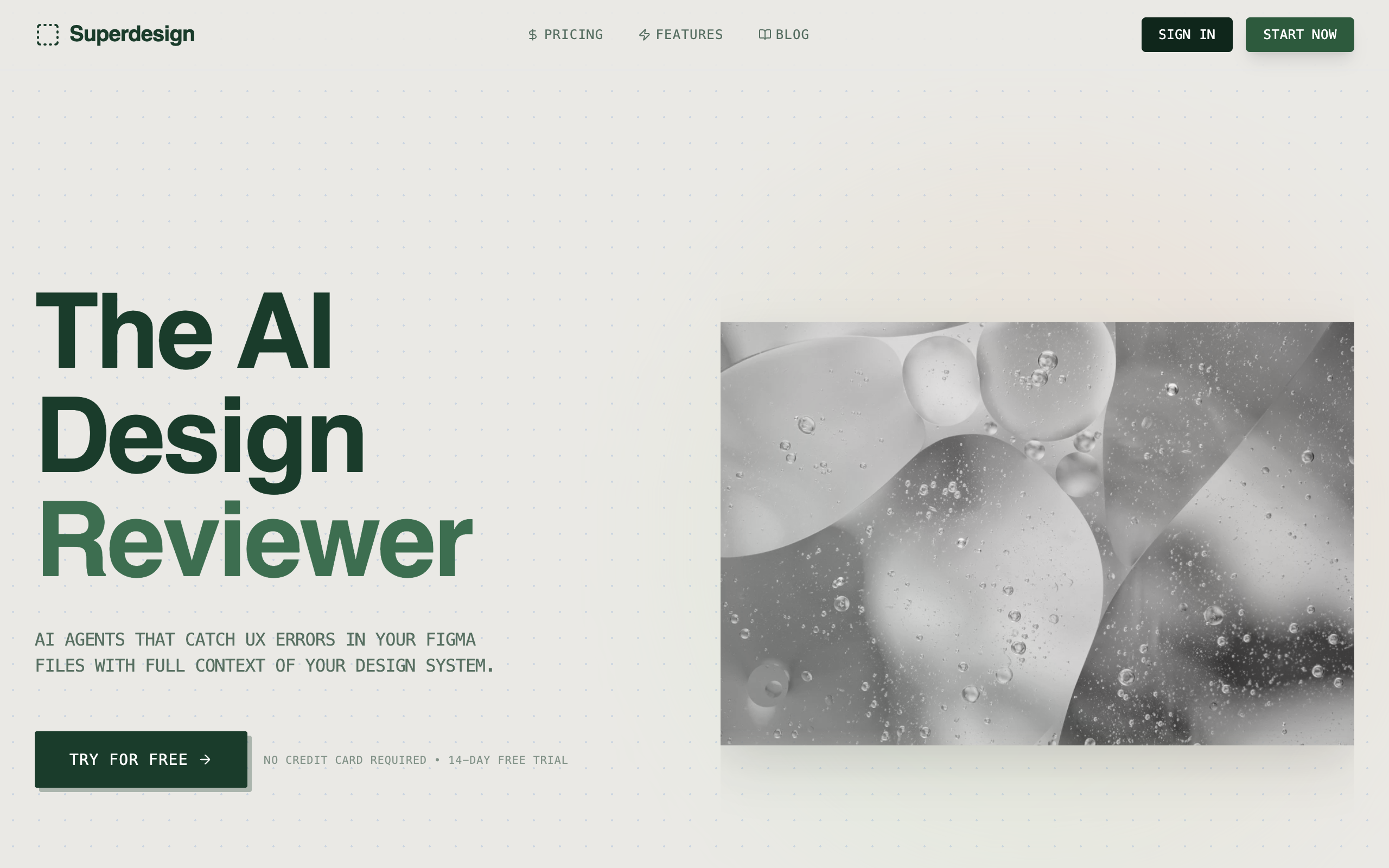
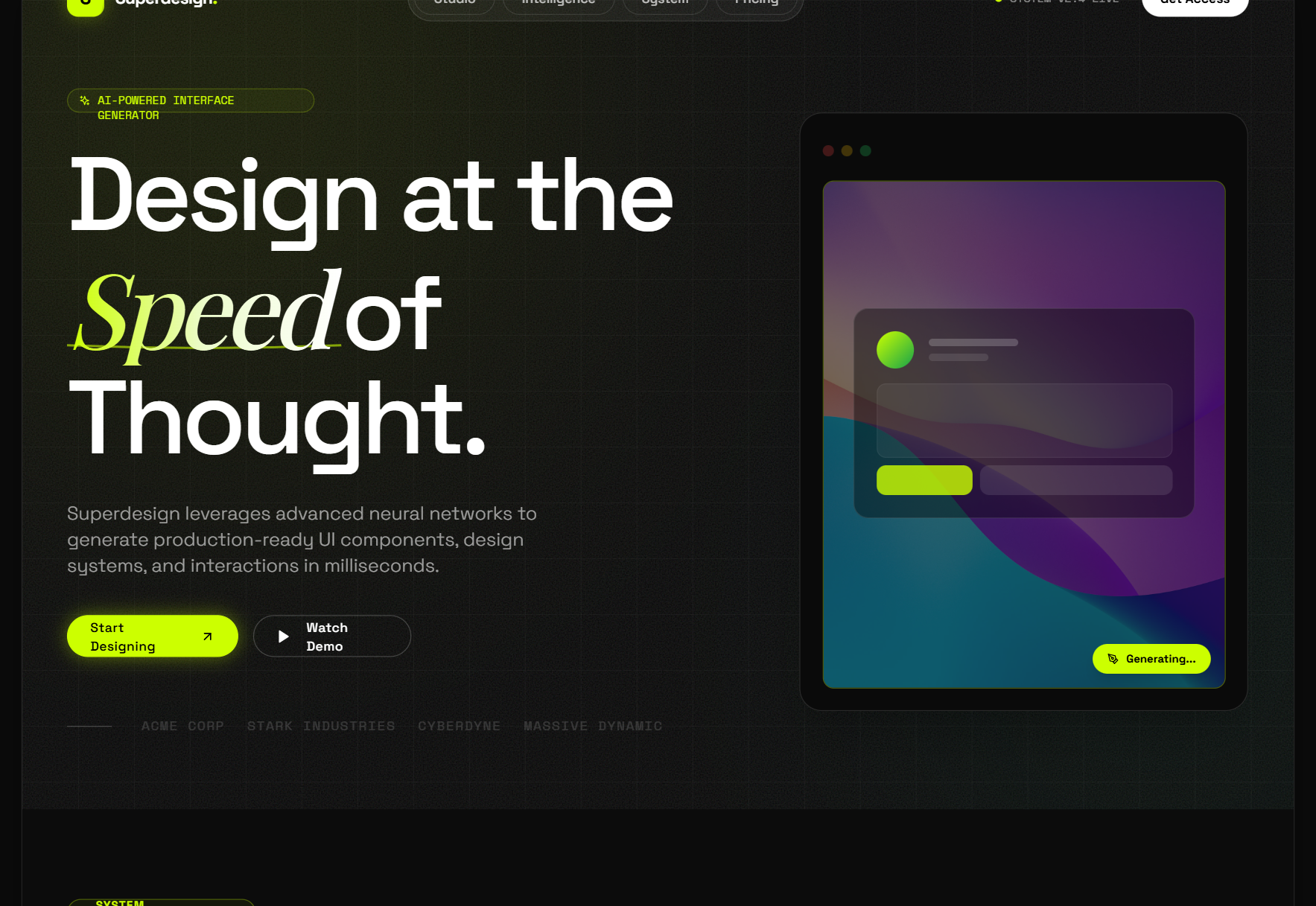
Superdesign is purpose-built for the vibe coder workflow. It's an AI design agent that lives inside your IDE (VS Code, Cursor, and Claude Code are all supported) and generates production-ready UI components and full-page designs directly from natural language prompts.
The core workflow is: open the Superdesign extension, describe what you want, get a polished design back in seconds. You can iterate conversationally ("make the sidebar wider," "switch to a dark theme," "add a notifications badge to the icon"), and the output is real code, not a mockup you still have to implement.
What sets Superdesign apart
- Codebase-aware design. Superdesign understands your existing components, your style system, and your tech stack. When you ask for a new dashboard widget, it generates something that matches your existing UI rather than introducing a brand-new visual language.
- DESIGN.md for consistent style. You can define your brand's visual rules in a DESIGN.md file, typography, color palette, spacing scale, component patterns, and Superdesign applies them automatically to every new generation.
- No canvas to manage. There's no Figma-style artboard to maintain, no component library to keep in sync with your code. The design and the code are the same thing.
- Multi-framework support. React, Vue, plain HTML/CSS, Superdesign outputs code that works with your stack, not a generic snippet you have to adapt.
- Instant variants. Want to see three different versions of a component? Prompt for alternatives and compare them side-by-side. No manual duplication of Figma frames.
Superdesign Pro is $20/month. Given that a single design session that previously required a Figma back-and-forth with a contractor can now be done in minutes, the ROI is immediate for solo developers and small teams.
2. V0 by Vercel: Best for React/Next.js component generation
V0 is Vercel's prompt-to-UI tool. You describe a component or page, and V0 generates React and Tailwind code for it. It's been around since late 2023 and has a strong community of developers using it to prototype interfaces quickly.
V0 is excellent for one-off component generation, especially if you're already in the Vercel/Next.js ecosystem. Where it falls short compared to Superdesign:
- No IDE integration, you work in V0's web UI, then copy-paste code into your project
- No codebase awareness, it doesn't know what components you already have
- Less contextual iteration, you're generating components in isolation, not as part of a cohesive design system
V0 is a good choice if you need quick React component scaffolding and don't mind the copy-paste workflow. For anything more integrated, Superdesign is the better pick.
3. Google Stitch: Best free option for design exploration
Google Stitch launched in March 2026 and quickly became the reference implementation for what the Google team called "vibe design." It supports voice-to-canvas input, DESIGN.md configuration files, and an MCP server for extensibility.
Stitch is impressive, especially for visual exploration and for teams that want to generate design mockups before committing to code. Its main limitations for developers:
- Still primarily a visual canvas tool, the output is designs, not production code
- No native IDE integration for Cursor or VS Code
- Early-stage product with significant rough edges
Stitch is worth bookmarking and checking back on quarterly. Right now, for a developer who wants to ship code, it's not yet the fastest path.
4. Framer: Best for landing pages and marketing sites
Framer has evolved from a prototyping tool into a full AI-powered website builder. Its AI features can generate landing pages, sections, and components from prompts, and the output is a published website, not just a design.
The trade-off: Framer is optimized for marketing sites and portfolios, not for product UI. If you're building a SaaS app with complex state, user flows, and edge cases, Framer's visual editor becomes a bottleneck quickly. It's also not IDE-native, you're working in Framer's own environment, not your code editor.
Good for: landing pages, portfolio sites, marketing sections. Not ideal for: product UI, component libraries, app interfaces.
5. Figma with AI plugins: If you can't fully switch
If your team is deeply invested in Figma and a full switch isn't on the table, there are AI plugins that add vibe-design-style capabilities to the existing Figma workflow:
- Figma Make, Figma's own AI feature that generates UI from prompts within Figma
- Locofy, Converts Figma designs to production-ready React, Next.js, or HTML code
- Anima, Similar Figma-to-code conversion with better component mapping
These plugins improve the Figma workflow but don't fundamentally change it. You're still maintaining a Figma file in parallel with your codebase, and the handoff gap still exists. They're a useful bridge, not a replacement for a code-first approach.
The real question: do developers still need a visual design tool?
Here's the honest take: for most developers building products in 2026, a traditional visual design tool like Figma is becoming optional. The workflow that's replacing it looks like this:
- Define your design system in a DESIGN.md or Tailwind config
- Use an AI design agent (like Superdesign) to generate new UI from natural language
- Iterate conversationally until the design matches your vision
- Ship, the output is already production code
This workflow is faster, keeps everything in one tool (your IDE), and produces output that's immediately shippable. The only thing it trades away is the pixel-perfect visual canvas that designers love, which, for a developer, was never the point anyway.
Figma still makes sense when you're working with a dedicated design team that needs to hand off to engineering. But if you're a solo developer, a vibe coder, or a small team where "the developer is the designer," the AI-first alternatives are now genuinely better for your workflow.
Comparison: Figma vs Superdesign for developers
| Feature | Figma | Superdesign |
|---|---|---|
| Works inside IDE | No | Yes (VS Code, Cursor, Claude Code) |
| Natural language input | Partial (Figma Make) | Yes, primary workflow |
| Codebase awareness | No | Yes |
| Output format | Design file (requires handoff) | Production-ready code |
| Design system consistency | Manual component library | DESIGN.md auto-applied |
| Learning curve for developers | High | Low |
| Price | $12-45/month | $20/month (Pro) |
Which Figma alternative should you choose?
The answer depends on your situation:
- You're a solo developer or vibe coder building a product → Superdesign. IDE-native, codebase-aware, generates production code.
- You're prototyping React components quickly → V0. Fast, free for basic use, strong Next.js integration.
- You need a marketing/landing page → Framer. Purpose-built for this use case.
- You want to experiment with AI design exploration → Google Stitch. Free, powerful, still maturing.
- Your team is Figma-committed and won't switch → Add Locofy or Figma Make to improve the handoff workflow.
For most developers reading this, the answer is Superdesign. It's the only tool on this list that was built specifically for the "developer who needs to design" workflow, with IDE integration, codebase awareness, and code-first output as its core value propositions, not add-ons.
How do you get started with Superdesign?
Ready to try an AI-first Figma alternative? Here's how to get started in under 5 minutes:
- Install the Superdesign extension from the VS Code Marketplace or the Cursor extension store
- Open any project in your IDE and activate Superdesign from the sidebar
- Describe the UI you want: "A settings page with a sidebar navigation and form sections for profile, billing, and notifications"
- Review the generated design, iterate with follow-up prompts, and export to your codebase
No design skills required. No Figma license. No context-switching. Just describe what you want and ship it.